
Hello to Loyalty: B2B Lifecycle Playbook for Repeat Revenue

From Hello to Loyalty: A Practical B2B Playbook for Turning First Conversations into Repeat Revenue
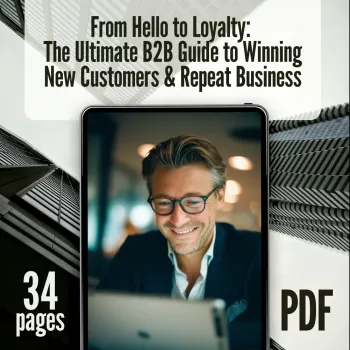
Winning in B2B rarely comes down to a single “yes.” It’s built through clear positioning, a reliable buying experience, and a customer journey that keeps delivering value after the first contract is signed. Our team created From Hello to Loyalty: The Ultimate B2B Guide to Winning New Customers & Repeat Business (Digital eBook) to help you structure that journey—so outreach turns into qualified opportunities, new deals turn into smooth onboarding, and satisfied customers turn into renewals, expansions, and referrals.
If you’re tired of “one-and-done” deals (or the constant pressure to keep stuffing the top of the funnel), this playbook is designed to help you build a lifecycle that compounds.
Who this guide is built for
This eBook is for B2B teams that want a repeatable system—not a collection of tactics that only works when one star rep is having a great month.
- Founders and small teams who need a repeatable system for acquiring and retaining B2B customers without adding headcount too fast
- Sales leaders looking to reduce “one-and-done” deals by tightening qualification, expectation-setting, and handoffs
- Marketing teams aiming to align messaging with the real buying journey—before, during, and after the sale
- Account managers and customer success teams who want a consistent retention rhythm that scales across accounts
- Service businesses and B2B SaaS teams that rely on renewals, retainers, or multi-step expansions
The “Hello to Loyalty” framework (a full lifecycle, not a single funnel)
Most teams try to fix retention by “trying harder” after the deal closes. We take a different approach: design each stage so the next stage becomes easier, smoother, and more predictable.
- First contact that earns attention: Lead with relevance, a clear point of view, and a reason to respond (not a generic pitch).
- Qualification that protects time: Confirm fit, urgency, stakeholders, and success criteria early so proposals go to the right buyers.
- Value proof that reduces risk: Use outcomes, use-cases, and credible signals to make the decision feel safer and simpler.
- A close that sets up retention: Define scope, timelines, responsibilities, and measurable success so delivery matches expectations.
- Onboarding that prevents churn: Fast time-to-value, clear communication, and early wins to build confidence.
- Loyalty loops: Consistent check-ins, reporting, and expansion triggers that make renewals a natural next step.
What changes when teams stop chasing “new” and start designing “next”
When you build the lifecycle end-to-end, the improvements stack. You’ll feel it in sales conversations, delivery, and forecasting.
- Messaging becomes easier: When you understand the entire lifecycle, the promise made in outreach matches the experience delivered after purchase.
- Pipeline becomes healthier: Better qualification reduces stalled deals and shortens the gap between discovery and decision.
- Retention becomes intentional: Customers don’t “accidentally” stay—clear outcomes, proactive communication, and success milestones keep them engaged.
- Referrals feel earned: Customers recommend vendors who make them look good internally and remove friction from ongoing work.
- Revenue becomes more predictable: Renewals and expansions reduce overreliance on constant top-of-funnel pressure.
This isn’t just a nice operational upgrade—retention has direct profit implications. If you want deeper context on the business impact, see Bain & Company on loyalty (The Value of Online Customer Loyalty) and Harvard Business Review’s overview of keeping the right customers (The Value of Keeping the Right Customers).
A simple operating system: what to standardize (and what to keep flexible)
Most “process” falls apart when it becomes rigid. Our team recommends standardizing the parts that protect customers from surprises and protect your team from rework—while leaving room for real discovery.
Quick-start checklist: 7 improvements that lift close rate and retention
For additional tactical retention ideas you can adapt to your model, HubSpot’s retention guide is a helpful companion reference (Customer Retention (Guide and Strategies)).
Lifecycle map: what to do at each stage
| Stage | Customer goal | Team action | Output to standardize |
|---|---|---|---|
| First contact | Decide if it’s worth responding | Lead with relevance, a clear outcome, and a low-friction next step | Short positioning statement + call-to-action |
| Discovery & qualification | Confirm fit and urgency | Ask structured questions about pain, impact, stakeholders, timeline | Qualification checklist + success criteria notes |
| Proposal & decision | Reduce risk and compare options | Connect solution to measurable outcomes, align on scope | Proposal template + scope boundaries |
| Onboarding | Get value quickly and feel supported | Kickoff, milestones, responsibilities, first-win delivery | Onboarding plan + communication cadence |
| Delivery & adoption | Achieve outcomes consistently | Track progress, remove blockers, document wins | Status update format + outcome tracking |
| Renewal & expansion | Decide what happens next | Review results, propose next objectives, align on terms | Business review template + renewal timeline |
How teams use the eBook in a real business week
In stock now (our team’s picks)
- From Hello to Loyalty: The Ultimate B2B Guide to Winning New Customers & Repeat Business | Digital eBook
- Diamond Rhinestone Steering Wheel Cover
- Christmas Ceramic Dinner Plate
FAQ
Is this guide more focused on getting new B2B customers or keeping existing ones?
It covers the full lifecycle from first contact through onboarding, retention, renewal, and expansion. Acquisition and repeat business are connected, so you’ll build a system where what you promise in sales is what you deliver in service.
Can a small B2B team implement this without a dedicated customer success department?
Yes—lean teams can implement it by standardizing qualification, defining a simple onboarding milestone plan, and setting a lightweight review cadence. The goal is consistency and clarity, not a bigger org chart.
What’s a practical first step to move from “one-time deals” to repeat revenue?
Define success criteria before the proposal, then build a 30-day onboarding plan that delivers an early win. That combination reduces churn risk and creates a natural opening for expansion conversations.















Leave a comment